Modern productions often face the same practical challenge. Whether capturing fast-moving documentaries, creating visually controlled commercials, or working with compact independent film crews, cinematographers must balance mobility, focal-length coverage, and professional optical performance within limited space and tight schedules.
The
Arles Zoom series was developed to meet these production needs.
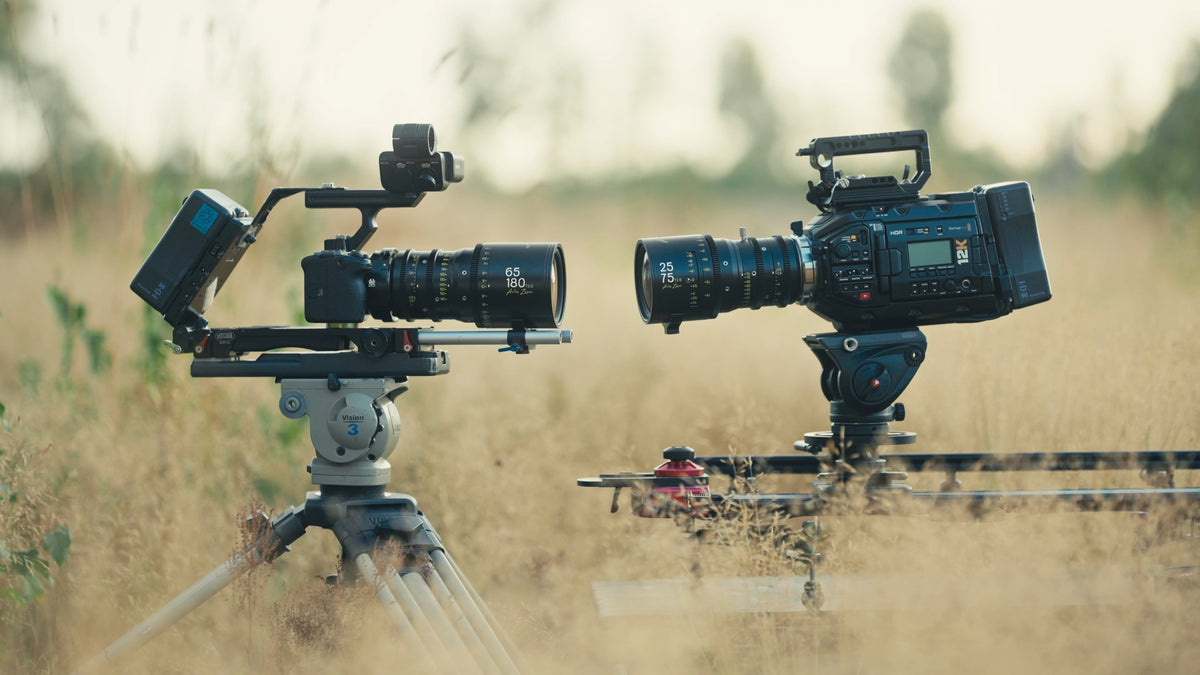
The 25–75mm T2.6 and 65–180mm T2.6 full-frame cine zoom lenses provide complete 25–180mm focal-length coverage. With a constant T2.6 aperture, full-frame optical design, and the signature Arles look, the two-lens set offers an efficient zoom solution for documentaries, narrative films, commercials, and independent productions.
Documentary and Mobile Production: Handling Fast-Changing Shooting Conditions
Documentary productions frequently operate in unpredictable situations where shooting opportunities can disappear within seconds. Camera teams must adjust framing quickly while managing the physical demands of extended handheld or mobile operation.
A documentary lens therefore needs to combine professional image quality with fast deployment and flexible handling.
Both
Arles Zoom lenses weigh approximately
1.8 kg and share a unified
φ95mm front diameter and M86 filter thread. Their compact and consistent design simplifies rig preparation and accessory changes, helping crews work more efficiently during handheld, shoulder-mounted, gimbal, and run-and-gun productions.
The parfocal design maintains focus throughout the zoom range, allowing cinematographers to adjust framing without repeatedly stopping to refocus.

@Woody James
Film Production: Covering Essential Focal Lengths with One Zoom System
Film production often requires multiple framing choices within the same scene. Moving from establishing shots to medium frames and close-ups needs to be efficient without interrupting the rhythm of production.
Traditional two-lens zoom configurations may leave gaps between focal ranges. The Arles Zoom system combines the 25–75mm T2.6 and 65–180mm T2.6, covering essential production focal lengths with a practical 65–75mm overlap.
The 25–75mm zoom covers frequently used wide-to-medium focal lengths, while the 65–180mm zoom extends into the medium-telephoto range for portraits, compression, and distant compositions.
The overlapping focal range creates a smooth transition between the two lenses, reducing unnecessary lens changes during scene transitions and rapid reframing.
In demanding shooting conditions, fewer lens changes can also reduce exposure to dust, moisture, and other environmental factors, helping crews maintain a more reliable workflow.

@Woody James
Commercial and TVC Productions: Why Constant T2.6 Matters
Commercials and branded productions place high demands on image quality, lighting control, and visual consistency. Cinematographers need to maintain a unified look while adapting framing and composition across different focal lengths.
Both Arles Zoom lenses maintain a constant T2.6 maximum aperture throughout their zoom ranges. This design helps minimize exposure changes during focal-length adjustments while providing greater creative flexibility in interiors, night scenes, and available-light shooting.
With a 43.5mm image circle, the lenses cover full-frame cinema cameras and professional video systems.
The 25–180mm focal range covers many of the core focal lengths commonly used in professional production. For wider perspectives, the system can be combined with the 14mm, 18mm, and 21mm Arles Prime lenses. The complete Arles Prime series extends from 14mm to 180mm, providing additional focal-length options while maintaining the visual consistency of the Arles family.
The Arles Zooms are color-matched with the Arles Prime series, maintaining consistent color rendering, skin tones, and out-of-focus characteristics. This allows cinematographers to combine zoom and prime lenses within the same production while preserving a unified visual language and reducing the need for extensive shot-by-shot matching in post-production.
@Łukasz Glewicz
Independent Films and Small Crews: Building an Efficient Lens Workflow
Independent filmmakers and smaller production crews often need equipment that balances professional image quality with practical workflow efficiency. A lens system must adapt not only to creative requirements, but also to different cameras, rigs, and production environments.
The short rear assembly of the Arles series supports interchangeable PL and EF mounts. Combined with DZOFILM manual, electronic, or VND Octopus adapters, the lenses can also be adapted to E, L, Z, RF, X, and DX mirrorless mounts.
This broad compatibility supports a wide range of shooting configurations, including handheld cameras, tripods, gimbals, dollies, robotic arms, cranes, and remote-head systems.
The two Arles Zoom lenses and eleven Arles Prime lenses share a unified φ95mm front diameter, M86 filter thread, and consistently positioned M0.8 gears. Follow-focus systems and filters can therefore move between prime and zoom setups with fewer adjustments.
At the optical level, the Arles Zoom series features an innovative four-group linkage optical design. Combined with its parfocal construction, the system maintains focus throughout the zoom range, allowing crews to move from wide to telephoto framing without repeatedly refocusing.
For smaller teams, this combination of focal-length coverage, accessory compatibility, and consistent operation makes it possible to build a professional lens system around a more efficient equipment package.
@Woody James
FAQ
1. What types of productions are the Arles Zoom lenses designed for?
The Arles Zoom series is designed for a wide range of productions, including narrative films, commercials, documentaries, short films, branded content, and independent productions. With 25–180mm focal-length coverage, a constant T2.6 aperture, and a compact design, the system provides a practical balance between image quality and on-set efficiency.
2. Do the Arles Zoom lenses maintain focus while zooming?
Yes. Both lenses feature a parfocal design that maintains focus throughout the zoom range, reducing the need to refocus when changing focal length.
3. Do the Arles Zoom lenses cover full-frame cinema cameras?
Yes. Both lenses feature a 43.5mm image circle and are designed to cover full-frame cinema cameras and professional video systems.
4. Can the Arles Zooms be used with Arles Prime lenses?
Yes. The Arles Zooms and Arles Primes share consistent color rendering, the established Arles look, and compatible cine-standard mechanical specifications. They can be combined within the same production to create a flexible prime-and-zoom lens package while maintaining a consistent visual style.
5. How do I choose between Catta Ace and Arles Zoom for my production?
Catta Ace and Arles Zoom are designed for different production priorities rather than serving as direct replacements for one another.
For filmmakers who prioritize lower weight, mobility, and rapid deployment, Catta Ace is well suited to solo operators and compact independent productions. Its three-lens set covers 18–135mm, including an 18mm wide-angle option, allowing filmmakers to configure their setup according to different project requirements.
For productions that prioritize consistent rendering, efficient focal-length coverage, and a professional workflow, Arles Zoom is designed to serve as a primary working zoom system. The 25–75mm and 65–180mm lenses cover the core 25–180mm range with 3× and 2.8× zoom ratios, compared with the approximately 1.9×–2.3× zoom ratios of individual Catta Ace lenses. This broader per-lens coverage can help reduce lens changes during production.
The constant T2.6 aperture also provides additional exposure flexibility compared with T2.9, making the Arles Zoom particularly suitable for commercials, narrative films, and branded productions that require consistent image control.
System integration is another key consideration. The Arles Zooms are color-matched with the Arles Prime series and designed to maintain consistent rendering across mixed prime-and-zoom setups. Catta Ace belongs to a separate lens family, so mixed-lens productions may require additional attention during matching and post-production.
In short,
Catta Ace emphasizes lightweight mobility and flexible configuration, while
Arles Zoom emphasizes production efficiency, extended focal-length coverage, and integration with the wider Arles system.
Shop Now
Shop the
Arles Zoom : 25-75mm





Share:
DZOFILM Black Friday 2026 — Enjoy Up to 38% Off